
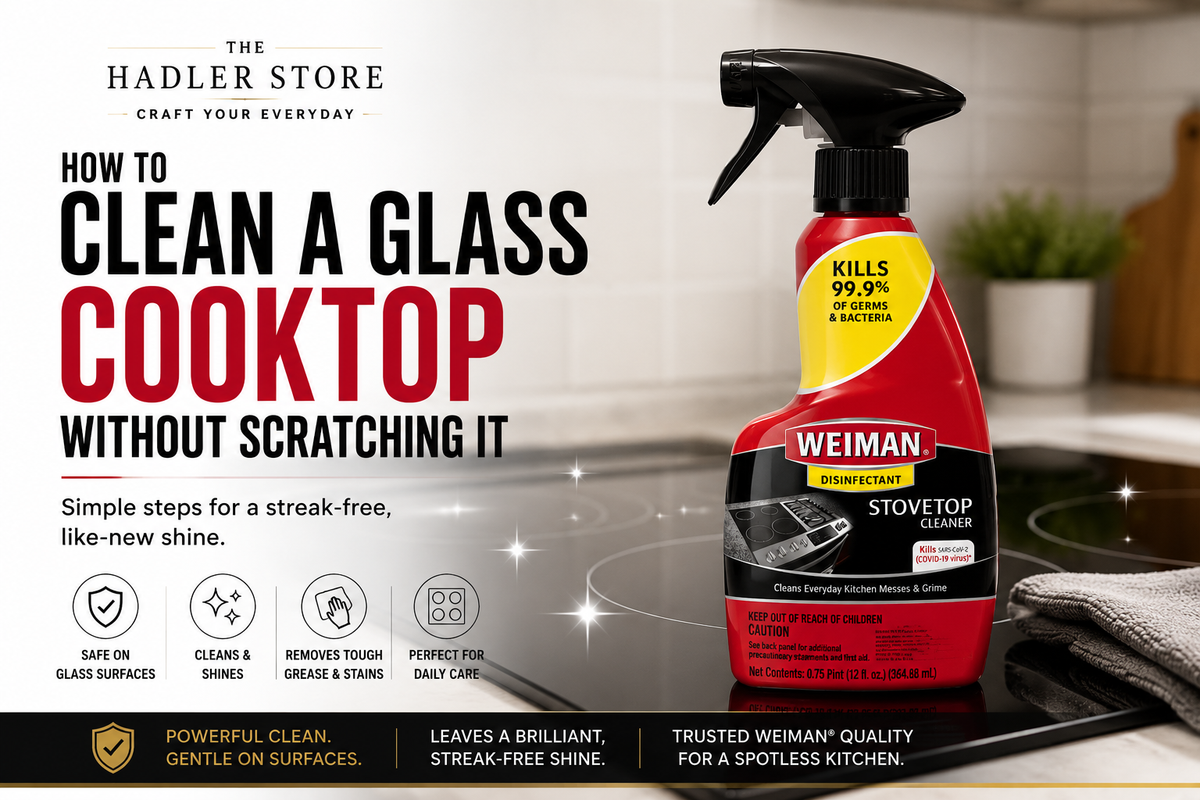
How to Clean a Glass Cooktop Without Scratching It
That milky, dull patch spreading across your glass cooktop is not dirt — it is damage. And once a glass-ceramic surface is scratched, no amount of scrubbing restores the shine. The good news: cleaning it properly is a genuinely simple three-step habit once you know what to avoid and which products are actually safe for this surface.

Why Glass Cooktops Scratch So Easily
Glass and ceramic cooktops look sleek until the first cloudy scratch appears — usually within the first few months of ordinary use. The surface is a tempered glass-ceramic composite, tougher than it looks, but with one significant weakness: anything gritty dragged across it while dry acts like sandpaper. Salt crystals, spilled sugar, even the dust that settles on a stovetop between uses can etch fine lines into the glass the moment you wipe with the wrong cloth or the wrong pressure.

Most of the hazy, dull patches people blame on poor quality glass are not manufacturing faults. They are thousands of micro-scratches built up from scouring pads, dry wiping, or all-purpose cleaners that were never formulated for this surface. Once you understand what causes the damage, avoiding it is straightforward.
The 3-Step Method That Actually Works
Step 1 — Clear Loose Debris While the Surface Is Barely Warm
Never clean a completely cold cooktop with dried-on residue, and never clean one that is still hot. Wait until the surface is just warm to the touch, then lift off crumbs and loose spills with a soft, dry microfibre cloth. Wiping while gritty debris is sitting on the glass is the single most common cause of scratching — the particles act as an abrasive between the cloth and the surface.
Step 2 — Apply a Cooktop-Safe Cleaning Cream
A purpose-made glass and ceramic cooktop cleaner — such as the Weiman Cooktop Cleaning Kit — is formulated to break down grease and burnt sugar without any abrasive grit. Apply a small amount directly to the cool surface and work it in gently with the non-abrasive pad in circular motions. Never side-to-side with pressure. The circular motion distributes cleaning action evenly without dragging residue across clean sections of glass.

Step 3 — Buff Dry with a Clean Microfibre Cloth
Leaving any cleaning residue to air-dry causes streaking and the dull, filmy appearance that makes a clean cooktop look dirty. Buff the surface immediately with a second, dry microfibre cloth until it squeaks clean. This final buff is what restores the glossy finish and prevents white residue lines from forming at the edges of the cleaned area.

What Never to Use on a Glass or Ceramic Cooktop
Several common cleaning approaches cause more damage than the original mess:
- Steel wool or scouring pads — designed for cast iron, not glass. They leave permanent fine scratches that catch light and worsen over time.
- Bleach or ammonia-based sprays — can react with the surface coating and cause discolouration that no cleaner will reverse.
- Dry paper towels on stuck-on residue — dragging dry debris across the glass is a guaranteed scratch. Always soften the residue before wiping.
- Standard household glass cleaners — many contain ammonia, which stains ceramic cooktop coatings even though it is safe for windows. If a cleaner does not explicitly state it is safe for glass-ceramic cooktops, it is not worth the risk on a surface that is expensive to replace.
- White vinegar directly on the surface — while useful in many cleaning applications, undiluted vinegar can dull the glass-ceramic finish over time with repeated use.
How to Remove Burnt-On Stains and Sugar Spills
Burnt sugar and boiled-over milk are the toughest cooktop stains because they essentially caramelise onto the glass during the heat of cooking. Here is how to lift them without forcing it:
- Apply the cooktop cleaning cream generously over the stained area and let it sit for 5–10 minutes. This softens the burnt residue instead of making you scrub harder.
- Use the flat edge of a plastic scraper at a shallow 30-degree angle to gently lift the softened residue. Never use a metal scraper, and never hold any scraper perpendicular to the surface.
- Wipe away the loosened debris, reapply a thin layer of cleaner, and buff dry as in Step 3 above.
For daily maintenance of the surrounding cooking zone — stainless trim, control knobs, and adjacent countertops — a Weiman Stainless Steel Cleaner keeps the whole area looking consistent without introducing a second product that may react differently with different surfaces.
How Often Should You Clean a Glass Cooktop
Frequency matters as much as method. Here is the routine that protects the surface long-term:
| Frequency | Task |
|---|---|
| After every use | Wipe spills with a soft cloth once the surface has cooled |
| Every few days | Light cream-cleaner pass to prevent residue bonding |
| Weekly | Full three-step clean with cooktop cream and buff |
| As needed | Plastic scraper for burnt-on spills immediately after discovery |
A cooktop that is properly cleaned consistently is easier to maintain than one cleaned aggressively once a month. Residue does not bond as strongly to a clean surface, and the weekly clean stays under five minutes.
Does This Work on Gas, Electric, and Induction Cooktops
The three-step method and Weiman's cooktop cleaner work on all glass-ceramic surfaces — electric radiant cooktops, induction cooktops, and the glass panels around gas burners. The key variable is the surface material, not the heat source. If the cooking surface is glass-ceramic, this method applies.
Gas cooktops with cast iron grates are a different cleaning challenge entirely — the grates, burner caps, and surrounding metal surfaces require different products. Weiman's range covers those surfaces separately.
Keeping It Streak-Free Between Deep Cleans
A properly cleaned cooktop stays cleaner longer — residue does not bond as readily to a surface that is free of old grime and micro-scratches. A few small habits make the weekly clean almost unnecessary:
- Wipe spills the moment the surface has cooled, before they can bake on during the next use
- Keep a dedicated microfibre cloth for the cooktop — not the cloth used for countertops or dishes, which may carry grit or cleaning product residue
- Do a light cream-cleaner pass every few days rather than waiting for a buildup that needs scraping
Consistent light maintenance is what protects the glass long-term — not occasional aggressive scrubbing that the surface was not designed to withstand.
Frequently Asked Questions
Can I use vinegar to clean a glass cooktop?
Diluted white vinegar can be used for light surface cleaning but is not recommended as a primary cooktop cleaner. Undiluted vinegar used repeatedly can dull the glass-ceramic finish over time. A purpose-made cooktop cleaning cream is safer and more effective for regular use.
What is the best cleaner for a glass cooktop?
A cream cleaner formulated specifically for glass-ceramic surfaces — such as Weiman Cooktop Cleaner — is the most reliable choice. It dissolves grease and burnt residue without abrasive grit, is safe for the glass-ceramic coating, and leaves a streak-free finish when buffed dry.
How do you remove white haze from a glass cooktop?
White haze is usually one of two things: hard water mineral deposits, or cleaning product residue left to air-dry. Apply a small amount of cooktop cleaning cream, work it into the hazy area with a non-abrasive pad in circular motions, then buff dry immediately with a clean microfibre cloth. For stubborn mineral deposits, a dedicated descaling product applied briefly then rinsed and buffed can help.
Can scratches be removed from a glass cooktop?
Deep scratches cannot be removed. Light surface scratches can sometimes be minimised by buffing with a cooktop cleaning cream, which fills micro-scratches slightly and improves light reflection — but this is a cosmetic improvement, not a repair. Prevention is far more effective than any remediation.
Is it safe to use a razor blade on a glass cooktop?
Only a dedicated glass cooktop scraper — which is a flat plastic or razor blade held at a very shallow angle — is safe for removing stubborn burnt residue. A standard razor blade held incorrectly or at too steep an angle will scratch the surface permanently. Always use a purpose-made plastic scraper at a 30-degree angle as the first tool of choice.
Where can I buy Weiman cooktop cleaner in Singapore?
We carry the Weiman Cooktop Cleaning Kit and Weiman Stainless Steel Cleaner at The Hadler Store — worldwide shipping from Singapore.
A Glass Cooktop Rewards Patience Over Force
The right cream cleaner, a soft touch, and a proper dry buff will keep a glass cooktop looking new for years — no scratches, no cloudy film, no aggressive scrubbing. The three-step method takes under five minutes once it becomes routine, and the weekly clean stays simple when spills are dealt with promptly rather than left to bake on.
Shop Home Cleaning Essentials at The Hadler Store
We carry the Weiman Cooktop Cleaning Kit and Stainless Steel Cleaner alongside a curated range of home cleaning products including Goo Gone, Gorilla, and Green Gobbler. Authorised retailer, worldwide shipping from Singapore.
Shop Weiman and Home Cleaning Essentials at The Hadler Store →
Also read: How to Remove Sticky Residue from Any Surface · How to Clean Your Coffee Machine — Complete Guide